


🧖♀️ Is Your Face Getting the Treatment It Actually Deserves?
FOREO Skin Tech Reality Check
5 questions. No filter. Your skincare routine will never be the same.
1. Be honest. How do you currently clean your face every night?
🔥 The Verdict on That Answer
An Honest, Ingredient-by-Ingredient Safety Analysis of FOREO Beauty Devices
If you've already read our guide on ( toxic ingredients hiding in luxury skincare ), you now know something most women don't. You know what benzene, PFAS, formaldehyde releasers, and 1,4-dioxane look like on a label — and you know why they don't belong anywhere near your skin.
Which raises a question I get asked constantly: "If traditional skincare products are so questionable, what CAN I trust?"
My answer, consistently and without hesitation, is FOREO.
Not because it is trendy. Not because celebrities use it. But because when I put FOREO through exactly the same ingredient scrutiny I apply to every product I recommend — it passed. Comprehensively.
Here is the complete, honest breakdown.
First — What Actually Touches Your Skin With FOREO?
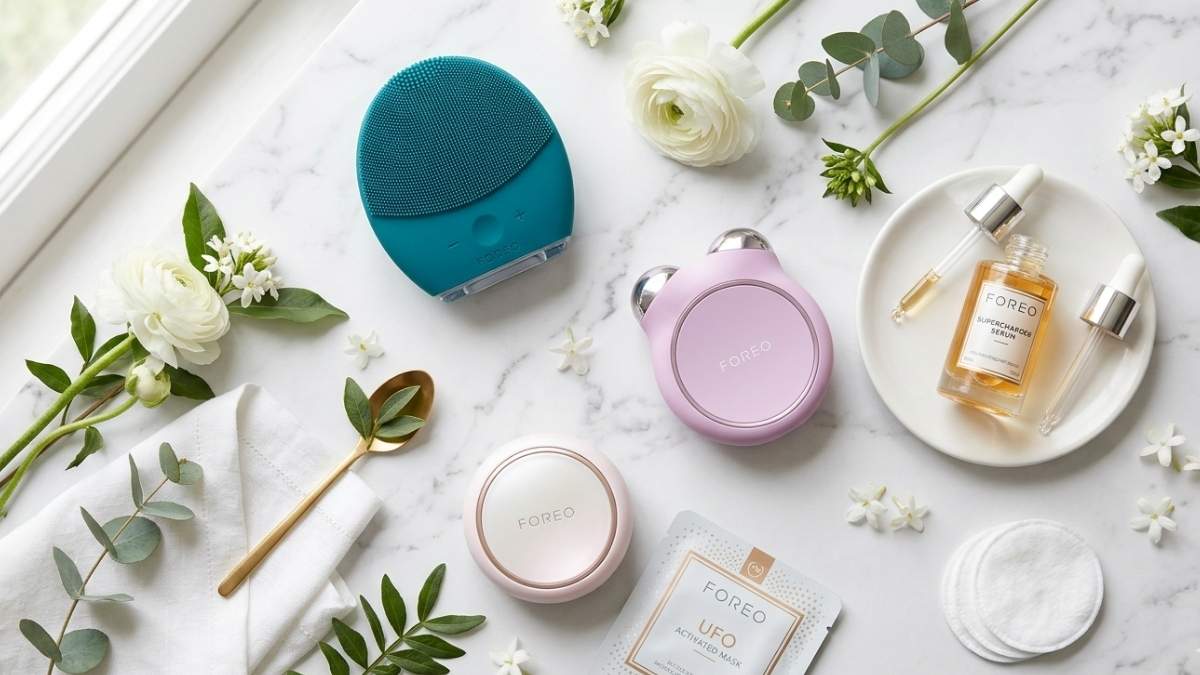
This is the most important question to ask about any beauty device — and most reviewers never ask it. With FOREO, there are two things that make contact with your skin:
01
The Device Itself
The medical-grade silicone surface that touches your face during every treatment — the LUNA, BEAR, or UFO body.
02
The Cleaning Spray
The liquid formula used to clean the device after each use. It rinses away — but its ingredients still matter.
The FOREO Device: Medical-Grade Silicone — What It Means and Why It Matters
Every FOREO device — the LUNA, the BEAR, the UFO — is made of what FOREO calls ultra-hygienic, medical-grade silicone. This is not a marketing term. It has a specific, verifiable meaning.
Medical-grade silicone is the same material used in surgical implants, medical tubing, and clinical equipment. Its defining characteristics are directly relevant to skin safety:
🚫 It is completely non-porous
Traditional cleansing brush bristles — nylon fibres — are microscopically porous. Bacteria, residual cleanser, dead skin cells, and moisture collect inside those fibres overnight. The next morning, you press that bacteria directly into your newly cleansed face. This is a dermatologically documented cause of breakouts, particularly around the chin and jawline.
FOREO's silicone surface has no pores. Nothing collects. Nothing accumulates. The device you pick up tomorrow is as clean as the device you put down today.
⚗️ It is chemically stable and nonreactive.
Medical-grade silicone does not interact with the products around it — not your cleanser, not your serum, not your skin's natural oils. It releases no particles, no chemical residue, and no degradation byproducts. This matters significantly for anyone with a compromised skin barrier, eczema, rosacea, or sensitivity.
🛡️ It contains no known carcinogens, endocrine disruptors, or harmful chemical compounds.
Cross-referencing FOREO's silicone against every ingredient category we flagged in our previous article — PFAS, formaldehyde releasers, coal tar dyes, parabens, benzene — there is nothing of concern. Medical-grade silicone is one of the most inert materials available to the beauty industry.
🌍 It does not break down into microplastics
Unlike traditional plastic-based devices, silicone degrades into silicon dioxide — essentially returning to sand. It does not shed microplastic particles that could be absorbed through the skin or enter the water supply.
Verdict on the device itself: ✅ Completely safe. No harmful ingredients. No contaminants of concern.
The FOREO Cleaning Spray: Every Ingredient Analysed
Now here is where I will be completely transparent with you — because this is the part of the FOREO story that most reviewers skip entirely.
That context matters enormously for the risk assessment. But let's go through every ingredient anyway — because that is what this guide is for.
The full ingredient list of the FOREO Silicone Cleaning Spray is:
Water (Aqua), Butylene Glycol, Glycerin, Sodium C14-16 Olefin Sulfonate, Sodium Lauryl Sulfate, Aloe Barbadensis Leaf Juice, Disodium Lauroamphodiacetate, Poloxamer 184, Decyl Glucoside, Chamomilla Recutita (Matricaria) Flower Extract, Thymol, Phenoxyethanol, DMDM Hydantoin, Triethanolamine.
Let's go through each one.
Water (Aqua)
✅ No ConcernsThe base of the formula. Safe, inert, no concerns whatsoever.
Butylene Glycol
✅ Safe for Rinse-Off UseA humectant and solvent — helps other ingredients dissolve and spread evenly. Considered safe at standard cosmetic concentrations. Occasionally flagged as a mild irritant for extremely sensitive skin, but not classified as harmful or carcinogenic.
Glycerin
✅ Completely safe.One of the most studied, most trusted ingredients in skincare. A naturally derived humectant that draws moisture to the skin. Found in everything from baby products to pharmaceutical formulations. No toxicity concerns at any concentration.
Sodium C14-16 Olefin Sulfonate
✅ Safe (Rinse-Off)A surfactant — the ingredient that creates lather and helps lift dirt from surfaces. Stronger than some alternatives, which makes it effective for cleaning a device but worth noting for anyone with reactive skin. Crucially, in this context it is rinsed off the device, not left on your face.
Sodium Lauryl Sulfate (SLS)
⚠️ Worth notingOne of the more heavily debated ingredients in personal care. It is not a carcinogen — this myth has been repeatedly disproven. What SLS is, is a potent surfactant that can strip the skin barrier in leave-on products. In the FOREO cleaning spray, SLS is cleaning a silicone device — not your face — then rinsed away entirely. The risk profile in this application is negligible.
Safety Rating: ⚠️ Worth noting — not a carcinogen, but a known irritant in leave-on products. In this rinse-off, device-cleaning application: low concern.
Aloe Barbadensis Leaf Juice
✅ Actively BeneficialOne of the most beneficial, most studied plant extracts in skincare. Anti-inflammatory, soothing, and hydrating. Completely safe at all concentrations.
Disodium Lauroamphodiacetate
✅ Gentle & SafeA mild amphoteric surfactant, frequently used in baby shampoos and sensitive skin formulations precisely because of its gentle profile. Helps boost foam while reducing the harshness of other surfactants in the formula.
Decyl Glucoside
✅ Excellent Safety ProfileA plant-derived, biodegradable surfactant made from glucose and fatty alcohols. One of the gentlest cleansing agents available — commonly found in natural and certified organic formulations. A genuinely clean ingredient.
Chamomile Flower Extract
✅ Actively BeneficialA natural anti-inflammatory and soothing botanical. Widely used in sensitive skin formulations. No toxicity concerns.
Phenoxyethanol
✅ Safe at Standard ConcentrationsA preservative used widely as a paraben alternative. Not a carcinogen, not a formaldehyde releaser, not an endocrine disruptor. The EU permits it at up to 1% in cosmetic formulations. One of the more safety-supported preservatives available — we recommended it as a paraben alternative in our clean beauty ingredient guide.
DMDM Hydantoin
⚠️ Worth knowingAnd here — I will be completely honest with you — is the one ingredient that gives me pause.
🔍 Full Transparency
DMDM Hydantoin is a formaldehyde releaser — one of the preservative names we listed in our previous article as an ingredient to be aware of. It slowly releases small amounts of formaldehyde over time to prevent bacterial growth. Formaldehyde is an IARC Group 1 carcinogen.
However — in a rinse-off cleaning spray used on a device that is then thoroughly washed before touching your skin, the actual exposure risk is extremely low. You are not applying DMDM Hydantoin to your face. You are spraying it onto silicone and rinsing it away.
My recommendation: rinse your FOREO device thoroughly after cleaning — not just a quick rinse, but a proper, full rinse under running water.
Safety Rating: ⚠️ A formaldehyde releaser — worth noting. Risk is very low in this specific rinse-off application but not zero. Rinse the device thoroughly.
Triethanolamine
✅ Safe at Standard ConcentrationsA pH adjuster used to balance the formula. Considered safe at cosmetic concentrations by regulatory bodies globally. Independent safety assessments have consistently found it safe at standard cosmetic use levels.
📊 The Overall Verdict
| Component | Harmful Ingredients | Verdict |
|---|---|---|
| FOREO devices (silicone) | None | ✅ Completely Safe |
| Cleaning spray — most ingredients | None of concern | ✅ Safe |
| Cleaning spray — SLS | Not a carcinogen, rinse-off only | ⚠️ Low Concern |
| Cleaning spray — DMDM Hydantoin | Formaldehyde releaser | ⚠️ Rinse Thoroughly |
The Smarter Alternative: DIY Device Cleaning
If you prefer to eliminate DMDM Hydantoin entirely from your routine — which is a completely valid choice — you can clean your FOREO device without the proprietary spray.
Clean Your FOREO the Chemical-Free Way
FOREO themselves confirm the device can be rinsed with warm water after each use. For a deeper weekly clean:
- Apply a tiny drop of your regular gentle, clean-formula cleanser — the same one you use on your face — directly onto the device surface.
- Work it gently across the silicone touchpoints with your fingertip for 10-15 seconds.
- Rinse thoroughly under running warm water until completely clear. Pat dry with a clean cloth.
Your skin. Your standards. Your call. 🙌
After going through every ingredient, every material, and every safety data point available — FOREO remains the most intelligently designed, cleanest beauty technology I have found in this category.
🏆 The Honest Recommendation
Six Minutes. Three Devices. A Routine Your Skin Will Be Visibly Grateful For.
For a woman who has done the work of understanding what goes on her skin, FOREO is the logical, safe, and genuinely effective next step in her routine.
🇺🇸 Special Offer Running Now
Exclusive deal currently available for USA Residents Only — click below to claim yours before it expires.
* Affiliate link | Offer valid for USA residents only | I only recommend what I believe in.
Disclaimer: This article contains affiliate links. Ingredient safety ratings are based on publicly available toxicological data and regulatory classifications and do not constitute medical advice. Always consult a board-certified dermatologist for personal skin health concerns.