

Skincare IQ Quiz
Is Your Moisturizer Slowly Betraying You? 🕵️
5 questions to find out how much your skin knows — and how much it’s been lied to.
Q1. You flip your moisturizer over and spot “Parfum” on the ingredient list. What do you do?
📣 The Verdict
Your "dermatologist-tested" moisturizer may be loaded with hormone disruptors, hidden carcinogens, and pore-clogging plastics. Here's what to look for — and what to use instead.
You squeezed the pump. You read "Dermatologist Tested. 24-Hour Hydration. Gentle for Sensitive Skin." It felt like a win. But what if that very moisturizer — the one promising to nourish you — contains harmful ingredients that are quietly working against your skin? I've spent over a decade decoding skincare labels, and today I'm pulling back the curtain on what mass-market brands don't want you to know.
By the time you finish reading, you'll know exactly which toxic chemicals in skincare to avoid, how to read a moisturizer label in three seconds flat, and which clean ingredients to look for instead. No chemistry degree required.
Part 1
Why Your Moisturizer Isn't Actually Working — The 3-Type Breakdown
Before we get into the harmful ingredients in moisturizers, you need to understand how moisturizers are designed to work. There are three types of moisturizing ingredients — and most drugstore products get the balance dangerously wrong.
Humectants — The Water Magnets
Glycerin · Hyaluronic Acid · Aloe Vera
These pull water into the top layer of your skin. The catch? If the formula lacks the next two types, humectants can actually pull moisture out of your skin instead, leaving you drier than before.
Emollients — The Smoothers
Ceramides · Squalane · Shea Butter
These fill microscopic gaps between skin cells. Mass-market brands often swap real emollients for cheap synthetic versions that feel silky but create a pore-clogging film that prevents your skin from breathing.
Occlusives — The Seal
Petrolatum · Plant Waxes · Beeswax
These lock water in with a physical barrier. When done right, they're essential. But many drugstore brands mix industrial-grade occlusives with silicones that trap bacteria, sweat, and dirt against your skin.
Most mass-market moisturizers are heavy on cheap emollients and silicones, light on real barrier repair, and packed with preservatives designed to survive years on a shelf. You're paying for a texture — not a treatment.
Part 2
5 Harmful Ingredients in Moisturizers — The Toxic Chemicals to Avoid
These are the five categories of moisturizer ingredients to avoid that I scan for first. They're cheap, extremely common, and appear in products labelled "hypoallergenic," "sensitive skin," and "dermatologist-tested" every single day.
Parabens — The Hormone Mimickers
Methylparaben · Propylparaben · Butylparaben
Parabens are preservatives that have been found to mimic estrogen and have been detected in human breast tissue. The EU has restricted several parabens. The US mass-market? Still uses them freely. Avoid anything ending in "-paraben."
Formaldehyde-Releasers — The Hidden Carcinogen
DMDM Hydantoin · Quaternium-15 · Diazolidinyl Urea
These ingredients slowly release formaldehyde — a known carcinogen — to keep bacteria at bay. They are a leading cause of contact dermatitis, yet they show up in "sensitive skin" and "hypoallergenic" products because they're extremely cheap. If you see DMDM Hydantoin on a label, put it back.
Fragrance / Parfum — The Legal Loophole
Fragrance · Parfum · "Natural Scent"
The word "fragrance" on a label is a legal loophole that can hide hundreds of undisclosed chemicals — including phthalates linked to reproductive harm. Remember: "unscented" is not the same as fragrance-free. Unscented products often use masking fragrances to cover chemical odours.
Silicones — The Illusion of Soft Skin
Dimethicone · Cyclopentasiloxane · Cyclomethicone
Silicones give that instant velvety feeling in the store — but they're occlusive plastics that sit on top of your skin, trapping sweat, bacteria, and dirt. Over time this leads to closed comedones (those tiny flesh-coloured bumps) and blocks better ingredients from reaching your skin.
PEG Compounds — The Contamination Risk
PEG-100 Stearate · Polysorbate 60 · Polysorbate 80
PEGs are emulsifiers whose manufacturing process frequently introduces 1,4-dioxane and ethylene oxide as byproducts — both classified as probable human carcinogens. You won't see them on the label, but if you see PEGs, the contamination risk is there.
"But wouldn't harmful ingredients be banned if they were dangerous?"
The United States has not passed a major federal cosmetics safety law since 1938. The FDA does not require pre-market approval for cosmetics. The industry that spends billions on marketing spends heavily on lobbying to keep their formulas unchanged. When it comes to toxic chemicals in skincare, you are your own regulator.
Part 3
How to Read a Moisturizer Ingredient Label in 3 Seconds
You don't need a chemistry degree to avoid harmful ingredients in moisturizers. You just need a short list and three seconds at the shelf. Flip the bottle. Scan the first ten ingredients. If you see any of the following, put it back.
| Ingredient | Also Known As | Why to Avoid |
|---|---|---|
| Parabens | Methylparaben, Propylparaben, Butylparaben | Mimic estrogen, detected in human breast tissue |
| DMDM Hydantoin | Imidazolidinyl Urea, Quaternium-15 | Slowly releases formaldehyde, a known carcinogen |
| Fragrance / Parfum | Parfum, "Natural Scent" | Hides hundreds of undisclosed chemicals including phthalates |
| BHA / BHT | Butylated Hydroxyanisole, Butylated Hydroxytoluene | Synthetic antioxidants linked to endocrine disruption |
| Triethanolamine (TEA) | TEA, Triethanolamine | Can react with other ingredients to form carcinogenic nitrosamines |
| PEG Compounds | PEG-100 Stearate, Polysorbate 60, Polysorbate 80 | Contamination risk with 1,4-dioxane, a probable carcinogen |
Part 4
Safe, Clean Moisturizer Ingredients — What to Look For Instead
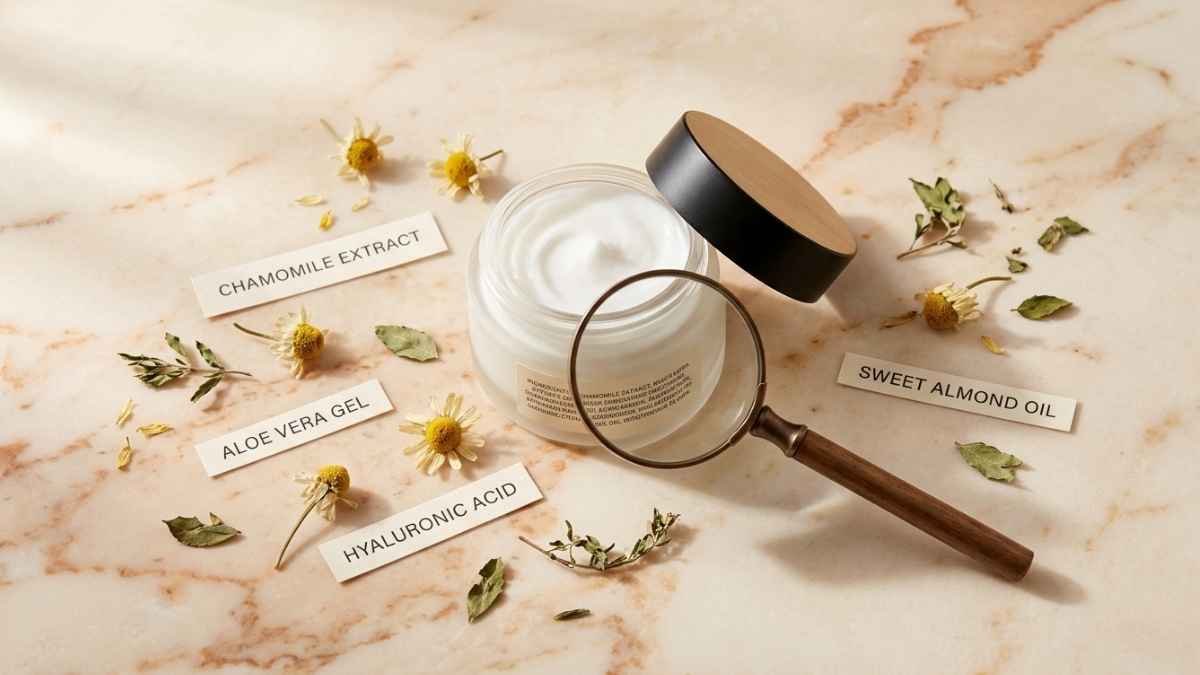
Avoiding toxic chemicals in skincare doesn't mean spending a fortune. It means knowing which clean ingredients actually repair your skin barrier rather than just masking dryness.
One bonus packaging tip: tubes and airless pumps beat jars every time. Dipping fingers into a jar introduces bacteria with every use, forcing brands to use heavier preservative loads — exactly the kind of harmful ingredients in moisturizers we're trying to avoid.
Your Skin Doesn't Need More Products.
It Needs Better Ones.
When I switched to a cleaner routine — cutting synthetic fragrances, parabens, and silicones — my "sensitive skin" stopped being sensitive. The random breakouts cleared. The redness healed. It wasn't magic. It was simply stopping a daily experiment with harmful ingredients on my own face.
You deserve a moisturiser that truly hydrates without compromising your health. Next time you're in the skincare aisle, flip it over. Read it like the informed advocate you are. Because now — you are.
Have you checked your moisturizer's label lately? Drop a comment below — let's expose the hidden toxic chemicals in skincare together.
Frequently Asked Questions About Harmful Ingredients in Moisturizers
What harmful ingredients should I avoid in a moisturizer?
The top moisturizer ingredients to avoid are parabens (anything ending in "-paraben"), formaldehyde-releasing preservatives like DMDM Hydantoin, fragrance or parfum, silicones like dimethicone, and PEG compounds. These are linked to hormone disruption, skin irritation, and carcinogen contamination risks.
Are parabens in skin care products really dangerous?
Parabens in skin care products have been found to mimic estrogen and have been detected in human breast tissue across multiple PubMed studies. Research has shown parabens can stimulate breast cancer cell growth at concentrations found in human tissue. The EU has restricted several parabens; they remain widely used in the US market. See the research links in the parabens section above.
What does "fragrance" mean on a skincare label?
Fragrance in skincare is a legal loophole allowing brands to list hundreds of undisclosed chemicals under a single word — including phthalates, which are known endocrine disruptors. Always choose products labelled "fragrance-free" rather than just "unscented," which can still contain masking fragrances.
What are the safest clean moisturizer ingredients?
The safest and most effective clean moisturizer ingredients include ceramides, squalane, and shea butter for barrier repair; glycerin and hyaluronic acid for hydration; and phenoxyethanol or potassium sorbate as gentler preservatives. Look for fragrance-free formulas in airless pump or tube packaging.
How do I read a moisturizer ingredient label?
Ingredients are listed in order of concentration — highest first. Focus on the first 10 ingredients. Avoid anything ending in "-paraben," DMDM Hydantoin, "fragrance" or "parfum," silicones like dimethicone, and PEG compounds. Look for ceramides, squalane, glycerin, and hyaluronic acid. Our 3-second label scan guide above walks you through this step by step.
Are toxic chemicals in skincare regulated in the US?
The US has not passed a major federal cosmetics safety law since 1938. The FDA does not require pre-market approval for cosmetics, meaning many toxic chemicals in skincare that are banned in the EU remain legal in US products. This is why knowing how to read labels yourself is so important.
References
- Darbre PD, et al. Concentrations of parabens in human breast tumours. Journal of Applied Toxicology, 2004. View on PubMed →
- Barr L, et al. Measurement of paraben concentrations in human breast tissue at serial locations across the breast. Journal of Applied Toxicology, 2012. View on PubMed →
- Khanna S, et al. Parabens enable suspension growth of MCF-7 breast cancer cells. Journal of Applied Toxicology, 2014. View on PubMed →
- Roltsch E, et al. Reducing paraben and phthalate exposure reverses cancer-associated changes in breast tissue. 2023. View on PubMed →
- Hlisníková H, et al. Phthalates and their effects on human health. Molecular Sciences, 2020. View on PubMed →
- Ding Y, et al. Phthalates exposure and female reproductive health. PMC, 2025. View on PMC →