

Is Your Face Wash Secretly Your Skin's Worst Enemy? 🫧
Skincare Reality Check
5 questions. No lab coat required. But your cleanser might need a lawyer.
1. Your face wash lathers up like a bubble bath at a foam party. You feel…
🔥 The Verdict on That Answer
You pump. You lather. You rinse.
That tight, squeaky‑clean feeling? Most of us grew up believing that means the face wash is working.
But what if that very cleanser — the one labeled “gentle,” “hypoallergenic,” and “dermatologist tested” — is quietly dismantling your skin’s protective shield?
I’ve spent over a decade decoding skincare labels, and today I’m pulling back the curtain on the face wash ingredients to avoid — the hidden chemicals mass‑market brands don’t want you to know about.
By the time you finish reading, you’ll know exactly which ingredients act like dish soap on your face, how to spot a cleanser that actually respects your skin, and what to look for instead. No chemistry degree required.
Why Your Face Wash Can Actually Hurt Your Skin — The Suds Trap
Before we get into the face wash ingredients to avoid, let’s talk about how cleansers work.
The key players are surfactants — short for “surface‑active agents.” Their job is to grab oil and dirt so water can rinse them away. Think of them like tiny magnets: one end loves water, the other end loves oil.
But not all surfactants are gentle.
According to a 2025 review in Colloids and Surfaces B: Biointerfaces, some surfactants don’t just remove dirt — they also:
- Strip away your skin’s natural “glue” (the lipids that hold skin cells together)
- Unravel protective proteins in the outer layer of your skin
- Trigger inflammation and let precious water escape
The harshest ones are called anionic surfactants — they carry a negative charge that aggressively binds to skin. They’re cheap, so mass‑market brands love them. They also make that satisfying, billowy foam we’ve been told means “clean.”
The simple truth: Foam sells, but it doesn’t equal healthy skin.
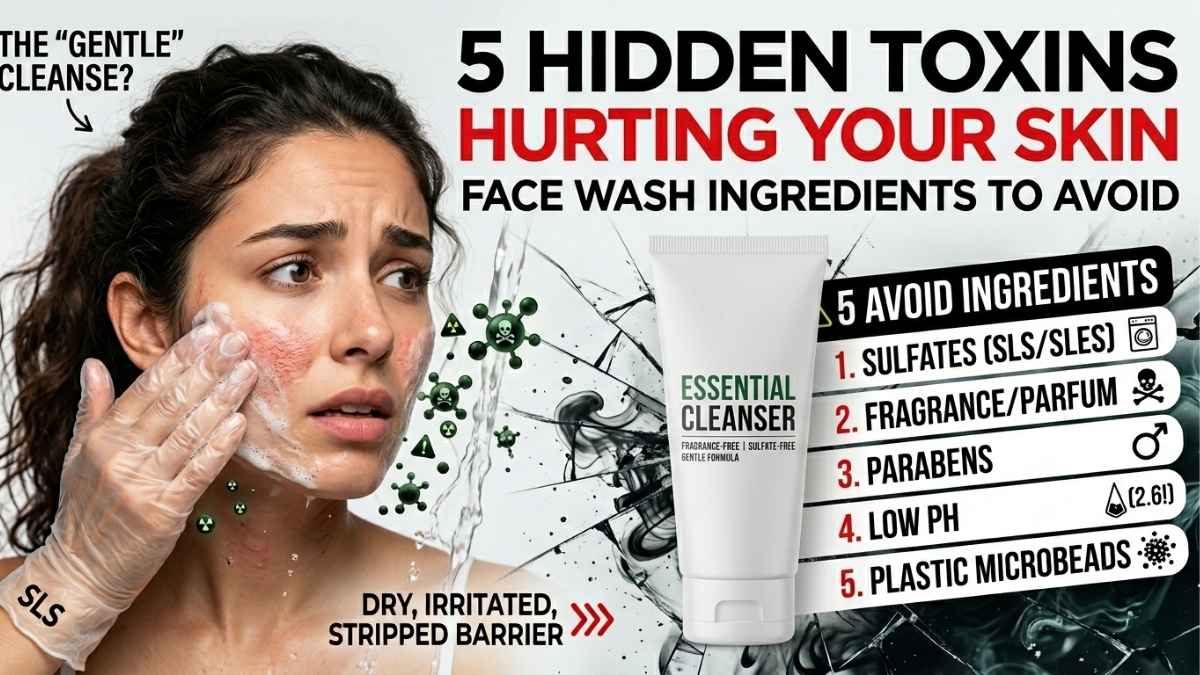
5 Face Wash Ingredients to Avoid
These are the five categories I scan for first. They’re cheap, incredibly common, and show up in products labeled “gentle” or “sensitive skin” all the time.
1. Sulfates (SLS & SLES) — The Dish Soap in Disguise
Sodium Lauryl Sulfate (SLS) · Sodium Laureth Sulfate (SLES) · Ammonium Lauryl Sulfate
These create that rich, fluffy lather. They’re also the same type of detergents used to degrease engines.
In fact, they’re so irritating that researchers use them in lab studies to intentionally cause skin rashes — so they can test how well healing creams work. If scientists use it to create irritation, why are we washing our faces with it every day?
The SLES twist: SLES is often marketed as the “gentler cousin,” but its manufacturing process can leave behind a contaminant called 1,4‑dioxane. The International Agency for Research on Cancer classifies it as “possibly carcinogenic to humans.” A 2025 Consumer Council test found 1,4‑dioxane in several face washes, with one exceeding EU safety recommendations.
If SLS is in the top five ingredients, put it back.
2. Fragrance / Parfum — The Legal Loophole
Fragrance · Parfum · Limonene · Linalool · Citronellol
“Fragrance” on a label is a secret door. It can hide hundreds of undisclosed chemicals — including phthalates, which are known endocrine disruptors (they mess with your hormones).
A 2025 Consumer Council test found many face washes contained fragrance allergens like limonene at levels high enough to require disclosure — but they weren’t listed.
Remember: “Unscented” is not the same as fragrance‑free. Unscented products often use masking fragrances to cover chemical smells. Always look for “fragrance‑free.”
3. Parabens — The Hormone Mimickers
Methylparaben · Propylparaben · Butylparaben
These are preservatives that prevent bacteria. A 2010 review in Critical Reviews in Toxicology confirmed parabens show “weak estrogen activity” in lab tests.
While the debate continues, many of us choose to avoid even weak hormonal interference when paraben‑free alternatives are everywhere.
4. Super Low pH — The Silent Stinger
Alpha Hydroxy Acids (AHAs) · Beta Hydroxy Acids (BHAs/Salicylic acid) without proper buffering
Your skin’s natural pH is around 4.5 to 5.5 — slightly acidic. The 2025 Consumer Council report found face washes with pH as low as 2.6. That’s more acidic than vinegar.
The report warned that such “excessively low pH may cause irritation and allergic reactions, leading to skin inflammation.”
If it stings when you use it, that’s not “active ingredients working.” That’s damage.
5. Plastic Microbeads — The Scrub That Scars
Polyethylene · Polypropylene
Those tiny beads that feel so satisfying? They’re plastic. They’re too sharp for facial skin and can cause micro‑tears in your barrier. Plus, they wash down the drain and end up in oceans.
If you want physical exfoliation, choose natural options like jojoba beads, oatmeal, or finely ground nut shells.
"The same harmful ingredients also show up in moisturizers..."
"But wouldn't harmful ingredients be banned if they were dangerous?"
The United States has not passed a major federal cosmetics safety law since 1938. The FDA does not require pre-market approval for cosmetics. The industry that spends billions on marketing spends heavily on lobbying to keep their formulas unchanged. When it comes to toxic chemicals in skincare, you are your own regulator.
How to Read a Face Wash Label in 3 Seconds
You don’t need a chemistry degree. Just flip the bottle, scan the first ten ingredients (they’re listed from highest to lowest concentration), and look for these red flags:
| Ingredients | Also Known As | Why to Avoid |
|---|---|---|
| Sodium Lauryl Sulfate | SLS, Sodium Dodecyl Sulfate | Industrial degreaser; used to cause irritation in lab studies |
| Sodium Laureth Sulfate | SLES | Often contaminated with 1,4‑dioxane, a probable carcinogen |
| Fragrance / Parfum | Parfum, Limonene, Linalool | Hides phthalates and undisclosed allergens |
| Parabens | Methylparaben, Propylparaben, Butylparaben | Weak estrogen activity in lab studies |
| Polyethylene | Polypropylene, “Microbeads” | Plastic that causes micro‑tears and pollutes oceans |
| pH below 3.5 | (on exfoliating cleansers) | Can cause irritation, stinging, and inflammation |
If you see any of these, put it back. Your skin will thank you.
Safe, Clean Face Wash Ingredients — What to Look For Instead
Avoiding harsh ingredients doesn’t mean you have to spend a fortune. It just means knowing what actually works with your skin.
Great news: A 2025 study in the Journal of Drugs in Dermatology tested a cleanser made with a new polymeric surfactant (Sodium Hydrolyzed Potato Starch Dodecenylsuccinate). The results? It maintained skin barrier integrity, reduced irritation, and did not strip lipids — all while effectively treating acne.
Clean Face Wash Ingredients ✅
- Amino‑acid cleansers — Sodium Cocoyl Isethionate, Disodium Cocoyl Glutamate — clean like soap but feel like lotion
- Plant‑based glucosides — Coco‑Glucoside, Decyl Glucoside — mild, effective, and biodegradable
- Self‑foaming pumps — A 2026 study found a self‑foaming gentle cleanser actually increased skin moisture and improved barrier function in people with dry skin
- Hydrating boosters — Glycerin, Ceramides, Hyaluronic Acid — they add moisture while you wash
- Salicylic acid (0.5%–2%) in a gentle base — You don’t need harsh sulfates to treat acne
Your Skin Doesn’t Need to Squeak. It Needs to Be Resilient.
When I switched from harsh sulfates and synthetic fragrances to gentle, barrier‑supporting cleansers, my “sensitive skin” stopped being sensitive. The tightness vanished. The random redness cleared.
It wasn’t magic — it was simply stopping a daily assault on my own skin barrier.
You deserve a face wash that cleanses without compromising your health. Next time you’re in the skincare aisle, flip it over. Read it like the informed advocate you are.
Have you checked your face wash’s label lately? Drop a comment below — let’s expose the hidden chemicals in cleansers together.
Frequently Asked Questions
What face wash ingredients should I avoid?
The top face wash ingredients to avoid are:
- Sodium lauryl sulfate (SLS)
- Sodium laureth sulfate (SLES)
- Fragrance / parfum
- Parabens
- Polyethylene microbeads
Are sulfates in face wash really that bad?
Yes. A 2025 PubMed‑reviewed study found that anionic surfactants like SLS are “strongly irritating” and disrupt the skin barrier so much they’re used as positive controls in irritation studies — meaning scientists use them to intentionally cause skin rashes.
What does “fragrance” mean on a face wash label?
“Fragrance” is a legal loophole that can hide hundreds of undisclosed chemicals, including phthalates — endocrine disruptors linked to reproductive issues. Always choose fragrance‑free products.
What are the safest face wash ingredients?
Look for:
- Amino‑acid‑based surfactants (sodium cocoyl isethionate)
- Plant‑based glucosides (coco‑glucoside)
- Hydrating ingredients (glycerin, ceramides)
How do I read a face wash ingredient label?
Ingredients are listed in order of concentration — highest first. Focus on the first 10. Avoid SLS, SLES, fragrance, parabens, and polyethylene. Look for gentle surfactants, glycerin, and ceramides.
"See which 5 ingredients to avoid in moisturizers"
References
- Seweryn A. Interactions between surfactants and the skin – Theory and practice. Colloids and Surfaces B: Biointerfaces, 2025. [PubMed]
- Johnson & Johnson. Safety Assessment of 1,4-Dioxane. International Journal of Toxicology, 2025. [PubMed]
- Consumer Council. Face Wash Test Results, 2025. [PMC]
- Hlisníková H, et al. Phthalates and their effects on human health. International Journal of Molecular Sciences, 2020. [PubMed]
- Darbre PD, et al. Concentrations of parabens in human breast tumours. Journal of Applied Toxicology, 2004. [PubMed]
- Waibel K, et al. A Novel Polymeric Surfactant-Based Cleanser for Acne-Prone Skin. Journal of Drugs in Dermatology, 2025. [PubMed]
- Self-Foaming Cleanser Study in Atopic Dermatitis. PubMed, 2026. [PubMed]