




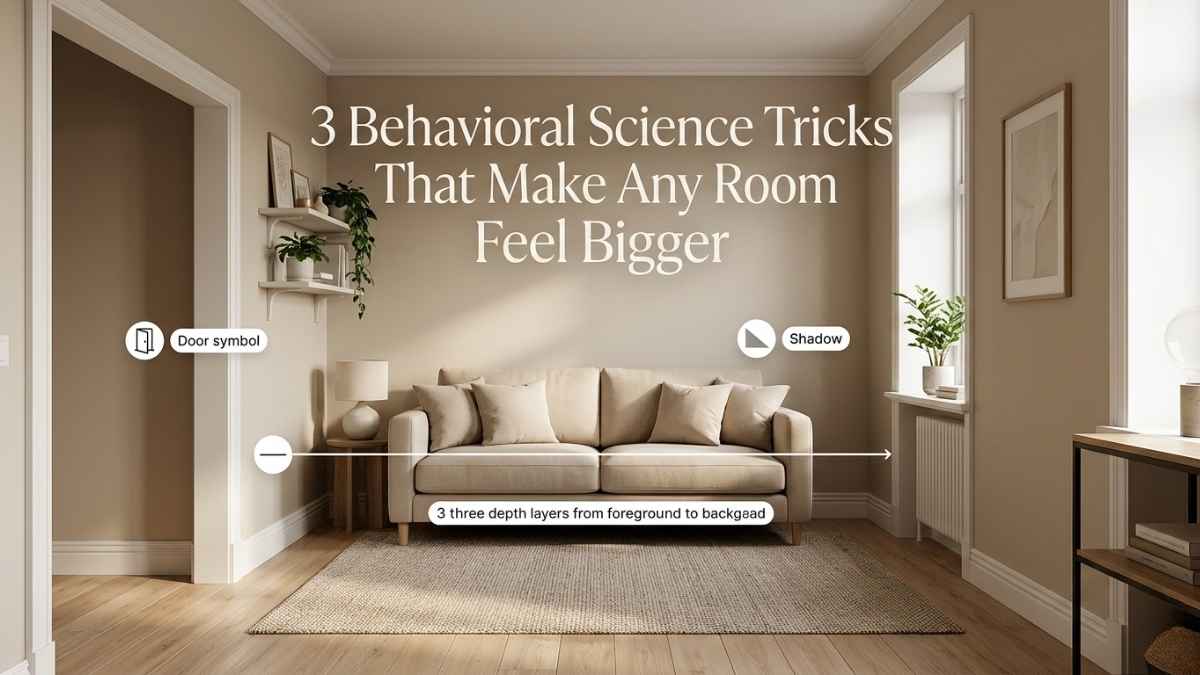
Is Your Room Playing Mind Games on You? 🧠🛋️
Home Psychology · 5 Questions
Your brain is judging your square footage right now. Find out what it’s saying.
1. You walk into your bedroom and immediately feel like the walls are… closing in. Your first instinct is to:
🔥 The Verdict on That Answer
Let me ask you something.
Have you ever walked into a friend's apartment that was smaller than yours — but felt bigger?
Annoying, right?
I used to think it was about square footage. Or maybe they had better light. Or maybe I just needed to throw away more stuff.
But then I started digging into the research. And here's what I found: Your brain is incredibly easy to fool.
In fact, most of what you feel about a room's size has almost nothing to do with actual measurements. It has everything to do with visual interruptions — tiny, unconscious stops and starts that your brain makes every time you look around.
Interrupt the eye too much? The room feels cramped.
Remove the interruptions? Suddenly — the ceiling lifts. The walls push back. The room breathes.
Today, I want to walk you through three of my favorite behavioral tricks for making a small room feel bigger. No renovation. No contractors. No buying a bigger house.
Just you, your space, and a little brain science.
Ready? Let's go.
Trick #1: The "Doorway Reset" Effect
Here's a quick experiment for you.
Stand in the doorway of your smallest room. Don't walk in yet. Just stand there.
What do you feel?
If you're like most people, you feel a tiny pinch of… something. Tightness. A little urgency. Like the room is already asking you to move out of the way.
That's not in your head. That's boundary activation.
Psychologists have known for decades that when you enter a space, your brain unconsciously measures the distance between you and the nearest exit. It's a survival thing. In a small room, that distance is short. So your brain quietly flags: "Limited escape. Stay alert."
That low-grade alertness? It makes the room feel smaller.
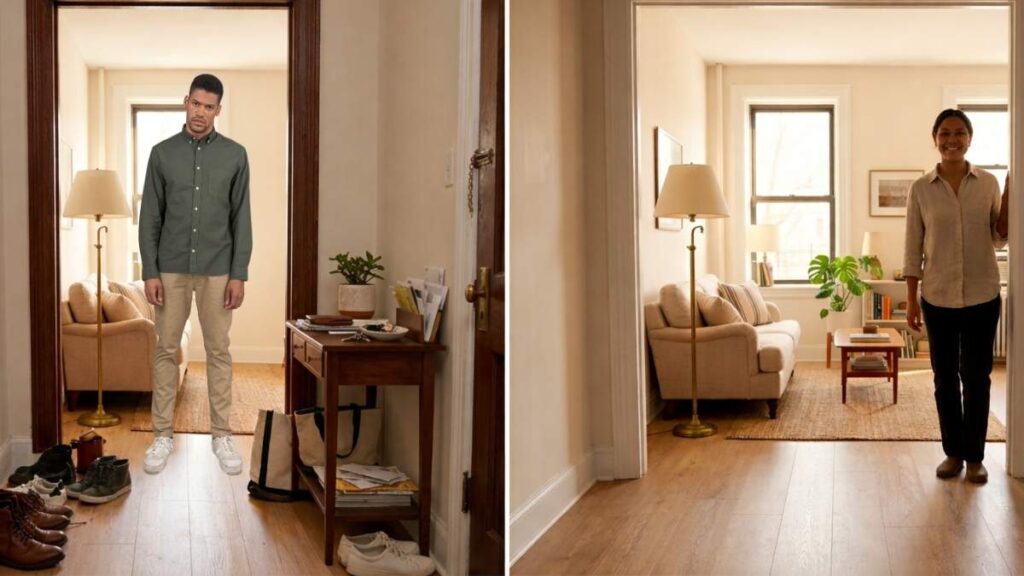
Here's the fix:
Leave the first three to four feet of floor space completely empty when you walk in. No shoe rack. No tiny table. No plant. Just open floor.
Try this right now:
Move one small object out of your doorway path. Just one. Put it in a corner. Then stand in the doorway again.
Do you feel the difference? Your shoulders might drop a little. Your eyes might move slower.
That's your brain recalibrating. It's saying: "Oh. I have room to land before I hit something."
That half-second pause tricks your entire nervous system into perceiving the room as larger.
One sentence summary: Clear the landing zone. Your brain needs a breath before it commits.
Trick #2: The "Horizontal Pause" Illusion
This one surprised me when I first learned it.
Most people assume that to make a room feel bigger, you should remove things. Fewer objects = more space, right?
Not exactly.
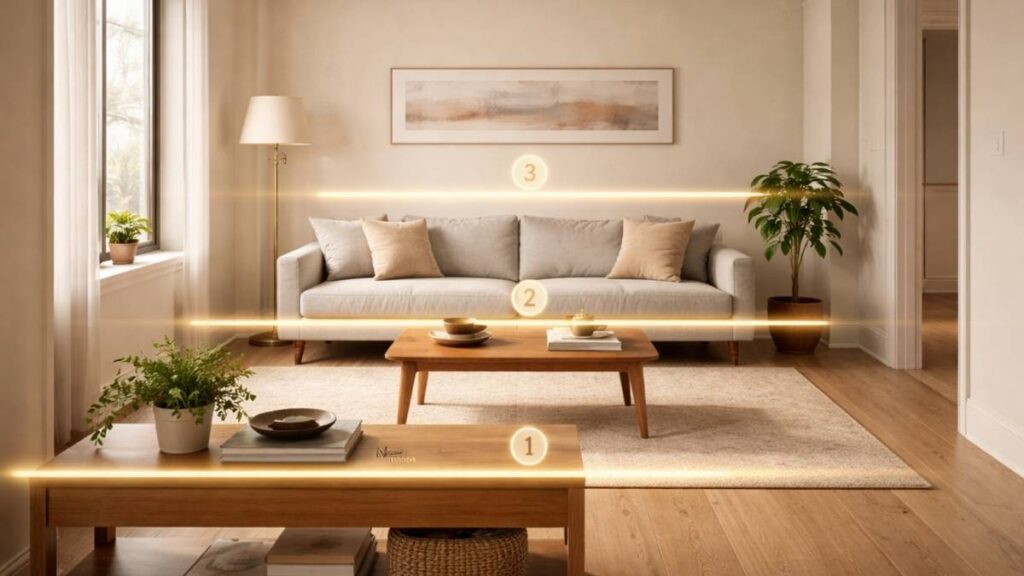
Here's what actually happens: Your eye moves across a room in tiny jumps called saccades. Jump, pause. Jump, pause. Jump, pause.
When your eye moves too fast — because there's nothing to pause on — your brain compresses the distance. Everything feels closer together. The room feels shorter, tighter, smaller.
The counterintuitive fix:
Add intentional visual pauses. Not more clutter. Specifically horizontal pauses at different depths.
Here's the formula I use:
- Near layer (about 3–5 feet from you): Place a long, low horizontal line. A console table. A low shelf. Even a long bench.
- Middle layer (about 6–10 feet): Another horizontal element. The back of a sofa. A rug edge. A long piece of art.
- Far layer (the back wall): A third horizontal. A picture hung at eye level. A floating shelf.
Why this works:
Your brain reads each horizontal pause as a distance marker. One pause = one layer. Three pauses = three layers of depth.
The room doesn't just look longer. It feels longer because your brain has to travel through each layer.
Try this tonight:
Take a long belt, a piece of string, or even a line of masking tape. Place it horizontally across your floor about four feet into the room. Just leave it there for an hour.
Walk to the far wall and turn around. Does the room feel deeper? Most people say yes. It's like magic — except it's just how your eye measures space.
One sentence summary: Three horizontal pauses = three layers of depth. Your brain counts every single one.
Trick #3: The "Shadow Gap" Principle
Okay, this one is my favorite. Because it sounds completely wrong until you try it.
Here's the common mistake: pushing all your furniture flat against the walls.
We do this because we think it saves space. But here's what actually happens in your brain: when a sofa touches the wall, your brain reads them as one continuous mass. Sofa + wall = one big visual block. And that block feels like a wall extension — which makes the room feel smaller and more enclosed.
The fix:
Pull every large piece of furniture exactly two inches away from the wall.
Not one inch. Not six inches. Two inches.
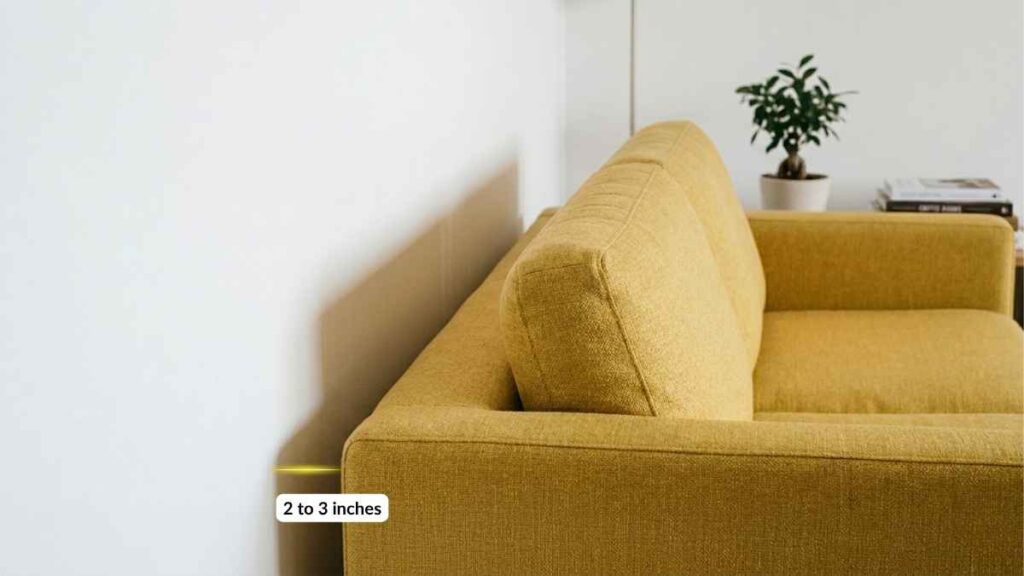
Here's why that specific number matters:
Two inches creates a shadow line. Your brain sees that shadow and registers: "There is space behind this object."
Even though the physical room hasn't changed, the perceived room now extends behind your sofa. Behind your bookshelf. Behind your dresser.
I've seen research suggesting that a two-inch gap can increase perceived depth by 15 to 20 percent — because your brain can no longer "wall off" that surface.
Try this right now:
Pick your largest piece of furniture. A sofa. A bookshelf. A large dresser. Pull it two inches from the wall. Just two inches.
Then walk to the opposite side of the room.
Look at the wall behind it. Does it feel like extra space now? Does the furniture itself look slightly smaller?
That's the shadow gap working. It's subtle. But once you see it, you can't unsee it.
One sentence summary: A two-inch shadow gap tells your brain there's room behind the furniture — and suddenly, there is.
The One Principle That Explains All Three Tricks
Let me tell you the secret these three tricks share.
Your brain measures space by interruptions.
| Trick | What It Interrupts | What Your Brain Registers |
|---|---|---|
| Doorway reset | Immediate boundary detection | "I have room to enter" |
| Horizontal pauses | Fast saccadic eye movement | "This room has depth" |
| Shadow gap | Wall-to-furniture continuity | "Space exists behind objects" |
Every time you interrupt a "small room" shortcut — the panic of a tight doorway, the rush of a fast-moving eye, the visual wall of pushed-back furniture — you force your brain to recalculate.
And almost every time, it recalculates upward.
You don't need a bigger home. You need to stop interrupting your own eye in the wrong places.
Your 3-Day Behavioral Experiment
Don't do all three at once. That's overwhelming. Pick one per day.
Day 1 — Doorway Reset:
Clear the first three feet inside your smallest room's entrance. Stand in the doorway for ten seconds. Notice your breathing. Does your chest feel looser?
Day 2 — Horizontal Pause:
Add one long, low object four feet into the room. A bench. A shelf. Even a line of masking tape. Walk to the far wall. Does the distance feel longer?
Day 3 — Shadow Gap:
Pull your largest furniture piece two inches from the wall. Walk around the room. Notice where your eye looks now. Does the wall behind it feel like it belongs to you?
Come back and tell me what you noticed. I'm genuinely curious.
Frequently Asked Questions
Q: Does the two-inch gap work for bookshelves too?
Yes. Even better — it creates a floating shelf effect without any drilling. The shadow underneath makes the whole unit feel lighter.
Q: What if I can't clear the doorway because my apartment is tiny?
Use a visual reset instead. Hang a mirror or a piece of light-colored art directly facing the door. Your brain will use it as a depth cue — a fake window into more space.
Q: Will these tricks work in a room with no natural light?
Absolutely. These are spatial perception tricks, not lighting tricks. Light helps, but it's not the engine. Your brain will still register the doorway reset, the horizontal pauses, and the shadow gap — even in a windowless room.
Q: Are these actually backed by science?
Yes. The Doorway Effect is well documented in environmental psychology. Saccadic eye movement research comes from visual perception studies. The Shadow Gap Principle is used by museum and gallery designers to make exhibition spaces feel larger.
Q: Can I combine these with regular decorating advice?
Please do. These tricks work alongside paint colors, mirrors, and furniture arrangement. They're not replacements — they're upgrades.
The Short Version (If You Only Have 30 Seconds)
Do these three things today:
- Clear the doorway zone — first three feet, empty floor
- Add three horizontal pauses — near, middle, far
- Pull furniture two inches from walls — create shadow gaps
That's it. No demo. No delivery trucks. Just you and a measuring tape.
Over to You
I've watched hundreds of people try these tricks. The ones who actually do them — even just one of them — always come back with the same sentence:
"I didn't think it would work. But it did."*
Your brain believes what your eye sees.
Give your eye an unbroken line. A clear doorway. A shadow gap.
Your brain will give you a bigger room.
Now go move something two inches.
"Love the science but want more practical, room-by-room ideas? Check out our complete small living room guide — seven hotel design secrets that make any space feel twice as big."
📚 Explore More from the Smart House Series
*• [7 Hotel Design Secrets for Small Living Rooms] — practical, room-by-room ideas*
• [How to Make Your House Smell Like the Ritz Carlton] — the neuroscience of scent
*• [The 5-Minute Japanese Cleaning Habit] — guest-ready every day*
*• [5-Star Hotel Bedroom on a Budget] — psychology for your sleep space*
*• [Are You a DIY Hero or Handyman?] — take the 2-minute quiz*